

What Are Intelligent Robots? Types, Capabilities, and Real-World Use Cases
- Mimic Robotic
- Jan 28
- 8 min read

In most production environments, robots started as repeatable motion on rails and arms. They welded, picked and placed, or transported materials with absolute consistency, but zero awareness. The current wave of physical AI changes that. The core question is no longer just what a robot can do, but how intelligently it can sense, decide, and adapt while it does it. That is the heart of the topic What Are Intelligent Robots.
This article steps back from single products and buzzwords and looks at intelligent machines the way an engineering or deployment team does. How they are defined. How they are architected. Which types actually exist in the field. Where they work reliably today, and where their limits still show.
Table of Contents
Defining intelligent robots in practical terms
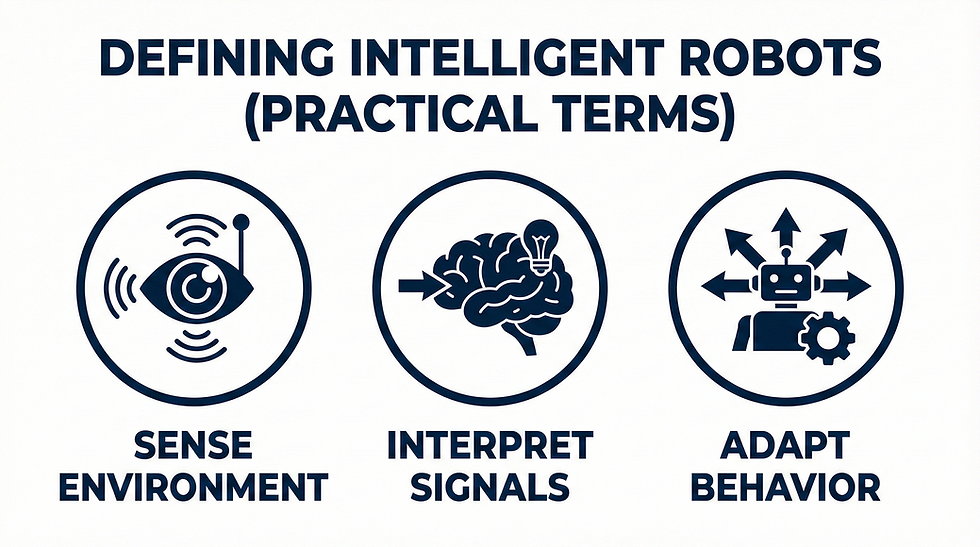
In academic language an intelligent robot is a machine with a physical body, sensors, actuators, and an embedded decision system that can perceive its environment and select actions in pursuit of a goal.
In production language that becomes simpler. An intelligent robot is any physical robot that can:
Sense its environment beyond simple limit switches.
Interpret those signals in context rather than following a fixed script.
Adapt its behaviour at runtime instead of relying only on hard coded routines.
Traditional industrial robots repeat a precise trajectory for years if needed. Intelligent robotics adds perception, memory, and adjustable behaviour. That shift is what most teams really mean when they ask What Are Intelligent Robots and how they differ from classical automation.
Core building blocks

Behind the friendly shell of a humanoid or the clean lines of a mobile base there is a fairly consistent architecture.
1. Mechanical structure
This is the visible body. It can be:
Fixed base arms in cells.
Mobile bases that navigate through space.
Humanoid or animal like forms designed for shared spaces with people.
Form factor has a direct impact on safety strategy, locomotion complexity, and the kinds of tasks that are realistic. For example the structural differences between humanoids and android style characters are examined deeply in the dedicated article on humanoid robots versus androids.
2. Sensors
Perception hardware gives the robot a stream of raw data. Typical stacks include:
Vision cameras and depth sensors.
Lidar or structured light for mapping and obstacle detection.
Inertial, force, and torque sensors for balance and contact.
Microphones and speaker arrays for conversational systems.
A detailed breakdown of how modern sensing translates into behaviour can be found in the smart robot overview on capabilities and sensors.
3. Actuators
Motors, servos, and drives turn high level decisions into movement. Design choices here determine smoothness, load capacity, backdrivability, and how safe the machine is when physically close to people.
4. Onboard compute and connectivity
Intelligent robots typically combine:
Low level controllers for motor control and safety.
An edge computer for perception and planning.
Network links to cloud resources for heavier models and fleet coordination.
This is where classical robotics meets AI inference infrastructure.
5. Intelligence stack
From a software perspective there is a ladder:
Rule based logic for deterministic control.
Machine learning models for perception and pattern recognition.
Planning and decision layers that evaluate options in real time.
Sometimes large language models to enable natural interaction and high level instruction following.
When discussing What Are Intelligent Robots with stakeholders, it often helps to clarify that the term refers to this entire integrated stack, not just the visible hardware or a single AI model.
Types of intelligent robot

There is no single taxonomy, but most production deployments cluster into a few useful categories.
Industrial and collaborative systems
These include classic industrial arms that have been upgraded with vision and adaptive control, as well as collaborative units that can share space with humans and dynamically adjust force, speed, and path planning.
Use cases range from bin picking and assembly to machine tending and quality inspection. Intelligent behaviour here often shows up as robust handling of part variation, unstructured bins, or changing fixtures.
Autonomous mobile robots
These are self navigating platforms in warehouses, factories, hospitals, and retail. They build maps, localise themselves, avoid obstacles, and coordinate with fleets.
The distinction between simple guided vehicles and intelligent navigation systems sits exactly at the point where the platform can interpret a changing environment and still execute its mission.
Service and social robots
Service robots operate directly around customers, patients, or guests. They handle guidance, check in, information, or delivery.
Social robots add a layer of expressive behaviour, speech, and non verbal cues. Pepper is one of the best known examples of a human facing social platform, with capabilities spanning navigation, conversation, face detection, and basic object recognition.
A deeper exploration of what makes a social machine trusted and comfortable to be around is covered in the article on companion robots.
Humanoid platforms
Humanoid systems bring together bipedal locomotion, dexterous manipulation, and human like proportions. They are still early in terms of widespread deployment, but they provide a powerful research and prototyping platform for environments designed entirely around human ergonomics.
Domain specific intelligent machines
Finally there are highly specialised platforms for surgery, agriculture, inspection, logistics, and more. The shared characteristic is the combination of perception, planning, and adaptive control tuned deeply to a single domain.
Understanding this landscape is essential when teams first explore What Are Intelligent Robots relevant to their own sector, rather than to robotics research in general.
Intelligent robots compared with traditional automation
To make the concept concrete, it helps to set intelligent robots side by side with classical automation.
Aspect | Traditional robot | Intelligent robot |
Core behaviour | Repeats fixed trajectories in structured cells | Adapts paths and actions based on live sensor data |
Environment | Requires predictable and constrained surroundings | Handles variability, moving people, and partial disorder |
Programming | Tight, low level scripting and teach pendant flows | Mix of learning based models and higher level task definitions |
Interaction | Minimal interaction, often fenced off | Designed for safe collaboration and potentially natural dialogue |
Lifecycle | Rarely updated once commissioned | Receives software, model, and workflow updates over time |
Recent work framing robotics as physical AI describes three broad levels: rule based systems, training based systems, and context aware systems that can interpret natural language and environmental cues. Intelligent robots occupy the latter two categories, where learning and adaptation are central.
Capabilities that matter in production

The phrase What Are Intelligent Robots can sound abstract until it is mapped to concrete capabilities that change outcomes on the floor or in front of customers.
Perception
Robots must see, hear, and feel in ways that are robust to noise, lighting changes, and imperfect data. Typical stacks include:
Visual perception for object detection, pose estimation, and scene understanding.
Audio pipelines for far field speech capture and localisation.
Proprioception for joint states, forces, and collisions.
This is where datasets, labeling quality, and model evaluation protocols matter as much as hardware.
Local intelligence versus cloud support
High value deployments tend to blend local autonomy with remote coordination.
Safety, motion control, and immediate responses remain on device.
Heavier models, fleet optimisation, and long term learning can leverage cloud backends.
The balance has direct implications for latency, privacy, and resilience.
Human aware behaviour
For robots that share space with people, competence is not enough. They need legible, predictable motion and social cues that align with human expectations. The long term evolution of social behaviour, trust building, and emotional design is explored further in the dedicated Pepper analysis at the Pepper robot article.
Integration into existing systems
Even the most impressive prototype fails if it cannot plug into scheduling, inventory, facility management, or customer service stacks. Intelligent robots need stable interfaces into the rest of the digital ecosystem, including conversational platforms and knowledge bases. That is where end to end robotics services become critical, spanning hardware selection, deployment, and lifecycle support.
Real world use cases by industry

Intelligent robots are already doing serious work across multiple sectors.
Healthcare
Surgical assistance with sub millimetre precision and tremor filtering.
Logistics inside hospitals, including medication, samples, and supply delivery.
Disinfection and cleaning in controlled environments.
Social engagement and guidance in reception, waiting areas, and long term care.
These deployments free clinicians from routine manual work while maintaining strict safety and traceability.
Manufacturing and logistics
Machine tending and assembly that tolerate variation in incoming parts.
Autonomous material movement and inventory flow.
Inspection systems that combine vision with anomaly detection at scale.
Here intelligent behaviour often means graceful failure management and recovery when reality does not match the CAD model or pristine simulation.
Retail, hospitality, and front of house
Wayfinding and concierge style assistance.
Queue management and triage for customer questions.
Branded experiences that merge information, entertainment, and service.
Humanoid and social platforms such as Pepper and NAO have demonstrated that well tuned interaction design can significantly improve engagement, as long as expectations are set correctly.
Education and research
Classroom companions that lead exercises, language practice, or STEM activities.
Research platforms for studying perception, locomotion, and human robot interaction.
These systems are often the first contact point when young people encounter the question What Are Intelligent Robots in a tangible way.
Benefits for organisations and teams

When well designed and deployed, intelligent robots offer a set of advantages that compound over time.
Higher consistency with better handling of real world variation compared to fixed automation.
Safer collaboration as robots become aware of people and adjust their behaviour rather than relying only on physical separation.
Richer data streams from sensors and logs, feeding into analytics and continuous improvement.
More flexible operations where workflows can be updated in software instead of retooling entire cells.
New experiences in customer facing roles, where physical presence plus conversational AI can deliver more natural interactions than screens alone.
From an engineering perspective, the most important benefit is not novelty but the ability to keep systems online and useful even when conditions change.
Future outlook for intelligent machines

The trajectory of intelligent robots follows the broader evolution of physical AI.
Several trends are already visible:
Context aware robots that interpret natural language instructions and adapt behaviour on the fly.
More capable mobile manipulation, blending navigation and dexterous handling in the same platform.
Wider use of simulation, digital twins, and generative tools to design, test, and optimise behaviours before deployment.
Increased specialisation of domain specific robots in medicine, agriculture, and field operations.
Tighter integration with enterprise systems so that robots become another node in a larger intelligent network, not isolated gadgets.
As these patterns mature, the answer to What Are Intelligent Robots will continue to shift from individual devices to entire ecosystems of coordinated, learning capable machines.
FAQs
What distinguishes an intelligent robot from a traditional one?
The key difference is adaptive decision making. Traditional robots execute predefined motions in controlled environments. Intelligent robots combine perception, reasoning, and learning so they can adjust to changes in surroundings, tasks, or human behaviour.
Do intelligent robots always require artificial intelligence models?
In practice most do use some form of AI, especially for vision and speech. However the overall system also includes deterministic control loops and safety layers. Intelligence is an emergent property of the entire stack, not just a single model.
Where are intelligent robots most mature today?
Manufacturing, logistics, and healthcare are currently the most mature sectors, with clear use cases and robust business cases. Customer facing and social roles are expanding, but they demand careful interaction design and expectation management, as discussed in depth in the companion, smart, and Pepper focused articles in the blog section.
How should an organisation start with intelligent robots?
The most effective starting point is a tightly scoped use case with measurable outcomes. From there, teams can work with specialists to select platforms, design workflows, and plan integration. Internal capability building and long term support should be part of the initial planning, not a later concern.
Are humanoid robots necessary for intelligent behaviour?
No. Many of the most successful intelligent robots are mobile bases or articulated arms without human like forms. Humanoid bodies become relevant when the environment and use case are designed around human scale, such as stair climbing, using human tools, or strong social presence, which is examined in more detail in the article on smart humanoid robots.
Conclusion
The question What Are Intelligent Robots is really a question about how far physical machines can go in sharing space, tasks, and goals with people. They are not just tools on rails, nor are they science fiction characters. They are engineered systems that combine mechanics, sensing, computation, and behaviour design into reliable, ethically deployed collaborators.
For teams planning their own roadmap, the most useful lens is not hype but fit. Which type of intelligent robot aligns with the environment, the workflows, and the people who will work alongside it. Which services and partners can sustain that system through its full lifecycle. The rest is an engineering and design conversation, not a slogan.


Comments