

Multilingual Robots: Design Patterns for Global Deployments
- Mimic Robotic
- Jan 12
- 11 min read

As robots move from laboratories into airports, clinics, hotels and homes, the expectation is simple but unforgiving: they should understand people as they are, in the language they are most comfortable with, without friction or delay. Multilingual Robots are no longer a research curiosity; they are becoming the front line of customer contact in global environments.
Designing one language aware robot is challenging. Designing a fleet of robots that can listen, speak and act across dozens of languages, accents and cultural norms demands clear patterns, disciplined architecture and a deep respect for human communication.
This article maps out concrete design patterns for global deployments of embodied conversational systems, from low latency speech stacks and language routing to persona design, safety and continuous learning. It assumes a physical platform, a conversational ai robot at minimum, and in many cases a humanoid form with expressive face, voice and gesture.
Table of Contents
Core design principles for language aware robots

Before choosing technology, it helps to treat language as part of the robotics system, not an add on. Four principles tend to hold across successful deployments of Multilingual Robots in the field:
Language is embodied: Speech, gaze, gesture, facial movement and personal space form one unit. A robot that understands Cantonese but uses inappropriate head motion or eye contact will still feel foreign. For humanoid platforms, this means the dialog system must drive facial rigging, blendshapes and body animation in sync with the spoken lines, just as in film grade digital humans.
Latency is part of personality: The time between human speech and robot response shapes perceived intelligence. Every extra second breaks trust. This is especially visible in crowded spaces where one multilingual conversational ai robot is serving a queue of guests. Language detection, speech recognition and response generation must be tuned for both speed and clarity, not just accuracy on a benchmark.
Language and task are coupled: A robot that can chat in thirty languages but only execute tasks in two will disappoint users. The command and control layer, the perception stack and the application logic must all be aware of language, not just the speech module.
Global consistency, local character: A brand will want consistent tone across its robot fleet worldwide, but local users need a robot that respects their social norms. Names, gestures, greetings, politeness strategies and even the robot’s backstory should adapt country by country.
These principles will inform the patterns that follow.
From single language assistant to global robotic companion

Many teams begin with a single language pilot. The jump from a monolingual prototype to a global deployment of Multilingual Robots is rarely a simple scale up. The system architecture needs to evolve along the way.
Stage one: single language, single venue: A robot speaks one language, in one environment, with one well defined mission. Often English in a lobby or exhibition hall. The focus is on navigation, safety, basic dialog and reliable handover to staff.
Stage two: two or three languages in one region: The same robot now supports tourists or mixed language communities. A common pattern is a primary language and one or two secondary options selectable through a touch screen or voice command. Here, language menus, code switching handling and clear feedback about the active language become essential.
Stage three: global fleet: Robots are deployed across hotels, hospitals, airports, and retail spaces in multiple countries. At this point, the project is less about adding more models and more about governance:
Who owns the translation memory
How new phrases and workflows are localized
How persona and tone remain aligned with brand values
How the physical robot, often a humanoid smart robot platform, is configured per location
For organisations planning such fleets, working with a dedicated robotics partner like Mimicrobotic helps align hardware, software and language strategy from the outset rather than treating language as a retrofit.
Architecture patterns for multilingual interaction

There is no single correct architecture, but certain patterns recur in production deployments. Each pattern describes how speech, language understanding, dialog management and action control are arranged.
Pattern one: central language hub
In this pattern, robots stream audio to a cloud based language stack and receive text or intent labels in return. The robots share a central brain for speech recognition, translation and natural language understanding.
Characteristics:
All languages managed centrally
New languages can be rolled out to the entire fleet from one place
Data collection and improvement are easier to manage
Considerations:
Requires robust connectivity and careful handling of network loss
Data residency and privacy laws can restrict cross border language routing
Latency can vary by region, affecting the perceived personality of the robot
This pattern works well for controlled spaces like hotels or airports with reliable networks and clear privacy notices.
Pattern two: edge first with cloud assist
Here, each robot carries one or more language models locally for the most common languages in that location. The cloud is used only for heavy tasks, long tail queries or languages used less often.
Characteristics:
Predictable latency for primary languages
Resilience when connectivity drops
Better control over sensitive audio and transcripts
Considerations:
Model updates must be orchestrated over the fleet
Local hardware must support on device speech and language processing
More complex routing logic between local and remote models
This pattern suits mission critical deployments where a conversational ai robot supports staff on a hospital ward or in manufacturing.
Pattern three: translation sandwich
In some deployments there is already a mature single language assistant that understands English. To support other languages quickly, teams use translation both on the input and output side.
Flow:
User speaks in local language
Speech is recognized and translated into the assistant’s core language
The assistant processes intent and generates a response
The response is translated back into the user’s language and spoken aloud
This can be surprisingly effective for information retrieval or simple tasks, but it comes with trade offs in nuance, error compounding and voice consistency. It is best treated as a bridge pattern, not the final state for Multilingual Robots that must build long term trust with users.
Pattern four: domain specific language packs
Instead of supporting each language at the same depth, the team creates language packs optimised for specific tasks. For example, a check in pack, a navigation pack, and a customer support pack, each with carefully curated phrases per language.
This pattern is common in smart service robot deployments where the mission is sharply focused and risk tolerance is low.
Embodiment, voice and character in physical robots
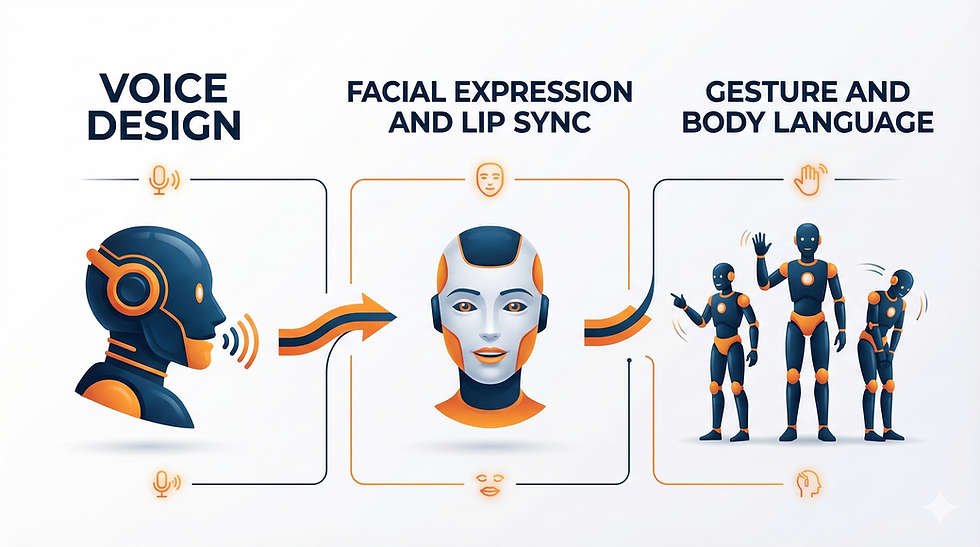
A language capable robot is more than an audio interface on wheels. The way it looks, moves and expresses itself must work in every culture it serves.
Voice design
For every language, teams must choose the right voice timbre, age, gender expression and speaking style. In some regions a calm, neutral voice is preferred; in others a more expressive or friendly style is expected.
Key considerations:
Alignment between voice and physical form
Small variations in speaking rate per language
Consistent pronunciation of brand names and technical terms
Support for multiple speaking styles for different tasks, such as confidential support versus public announcements
Facial expression and lip sync
For humanoid platforms and companion robots, the challenge extends to the face. The system must drive facial rigging, eye motion and micro expressions in sync with speech, different for each language’s rhythm.
Production tested workflows from film and real time digital human pipelines are invaluable here:
Use performance capture to build a library of expressions that feel natural for core markets
Refine blendshape rigs to handle phonemes from each target language
Ensure real time lipsync stays within a low error threshold, especially in close range interactions
In social or emotional use cases, expressive companion robots rely on this subtle choreography as much as on text content.
Gesture and body language
Gestures that are friendly in one culture can be rude in another. Multilingual Robots must be able to vary:
Greeting gestures
Personal space behaviour
Indicating directions
Use of touch, if the form factor supports it
These elements should be configurable per country and tested with local users just as carefully as phrasing and vocabulary.
Data, localization and continuous learning at scale

Language is not a one time setup. Once robots are in the field, real users will speak in ways that training data did not fully anticipate. Managing that reality is a continuous process.
Central phrase and intent catalog
Maintain a single source of truth for:
Supported intents and dialog flows
Source phrases for each flow
Approved translations and local variants
Terminology glossaries per region
This catalog can then feed both the language models and the authoring tools used by conversation designers. It also acts as a reference during audits and updates.
Human in the loop review
For any large fleet of Multilingual Robots, some proportion of interactions should be sampled and reviewed by native speakers. Goals:
Catch systematic misunderstandings
Discover new phrases and synonyms for high value tasks
Identify cultural or tonal mismatches in responses
Continually refine safe response patterns
Shared learning across markets
When a robot learns a better way to answer a question in one country, that knowledge can often inform responses elsewhere. This is where a well designed central platform across industries and sectors becomes powerful: improvements in one deployment can flow into others, subject to legal and privacy constraints.
Safety, consent and regional compliance

Language capability comes with responsibility. A conversational ai robot is often the first point of contact in sensitive settings, from healthcare check in to banking assistance.
Key considerations:
Consent and transparency: Users should know when audio is recorded, where it is processed and how transcripts are stored. Any use of data for training must be transparent and opt in where required by law.
Content policies per region: What is considered acceptable small talk, humour or advice can vary significantly. Response templates and generative components should be constrained by region specific guidelines.
Data residency and routing: Some countries require that sensitive data never leaves their borders. This strongly influences whether Multilingual Robots rely on central language hubs or localised processing.
Handover to humansIn high stakes domains, the robot must know when to hand over to a human agent, and do so gracefully in the user’s language.
Robots that interact with children, elderly users or patients demand additional layers of review, including local regulatory consultation.
Comparison table of multilingual design patterns
Pattern name | Typical use case | Strengths | Trade offs |
Central language hub | Global fleets in connected venues | Easy rollout of new languages, unified data | Dependent on network, complex legal routing |
Edge first | Hospitals, manufacturing, mission critical | Low latency, robust when offline, privacy | Heavier hardware, complex updates |
Translation sandwich | Fast expansion from single language core | Rapid coverage, reuse of existing system | Nuance loss, error stacking, voice mismatch |
Language packs | Focused service or kiosk scenarios | High reliability for narrow tasks | Limited flexibility outside defined scripts |
Applications across industries and environments

Multilingual Robots are already moving quietly into multiple sectors. Concrete applications include:
Hospitality and travel: Robotic concierges that can check in guests, answer questions about transport, and give directions in the visitor’s preferred language, while maintaining brand aligned persona and gestures.
Healthcare: Wayfinding and triage support in hospitals, where a conversational ai robot helps patients navigate complex buildings and provides pre appointment instructions in simple, clear language.
Retail and banking: In store assistance for product questions, account support, and educational content about financial products, with robots adapting phrasing to local regulation and cultural expectations.
Public spaces and transport: Guide robots in airports and stations that support travellers at any time when human staff are busy, switching fluidly between languages within a single interaction.
Education and culture: Museum or campus guides capable of storytelling, language learning support, and personalised tours that reflect the cultural background of the visitor.
These deployments often use a mix of humanoid platforms and more compact smart robots, with different expectations around expressiveness, mobility and social presence. The common thread is reliable, respectful communication across languages.
Benefits of a well designed global robot fleet

When the architecture and character design are handled with care, organisations see benefits beyond basic translation.
A consistent, high quality brand presence across locations and languages
Reduced strain on frontline staff, who can focus on complex or sensitive cases
Better data about user needs and questions, aggregated across regions
The ability to pilot new services in one market and quickly roll them out elsewhere
Stronger trust from users who feel addressed in their own language and cultural frame
Working with specialised robotics service providers and language experience teams, such as those described on Mimicrobotic services, helps turn these benefits into repeatable practice rather than one off installations.
Challenges and failure modes to anticipate

Delivering Multilingual Robots at scale is demanding work. Common pitfalls include:
Underestimating acoustic diversity: Background noise, accents and speech styles vary widely across venues. Models that perform well in a lab can degrade in a busy lobby or open street.
Partial localisation: Interfaces where only the voice is localised but screens, signage or help content remain in a default language. This undermines trust immediately.
Inconsistent persona: When different teams or vendors handle localization for different countries, the robot can feel like a different character in each market.
Unclear ownership: If no single group owns the language system end to end, improvements and bug fixes fall between teams.
Compliance surprises: Late discovery of regional laws around biometrics, recording or cloud processing can delay or block deployments.
Addressing these early requires clear governance, shared guidelines and close collaboration between robotics, conversation design, localisation and compliance teams.
Future outlook for language capable robotics

The near future of Multilingual Robots will be shaped by three converging trends:
Stronger on device language models: Hardware improvements will make it feasible for robots to run compact multilingual speech and language models locally, reducing dependence on the cloud while preserving quality.
Deeper integration of perception and language: Robots will not only understand what is said, but who is speaking, what they are looking at, and how they are moving. Gesture, gaze and spatial context will inform language understanding, making interactions more natural and efficient.
Richer digital characters on robotic platforms: The line between film grade digital humans and physical robots will continue to blur. Workflows from scanning, rigging, motion capture and real time rendering will inform the design of robot faces, skin shaders, eye motion and subtle behaviour, resulting in more believable, trustworthy companions.
As these developments mature, we can expect conversational ai robot systems that feel less like interfaces and more like long term collaborators in shared spaces.
FAQs
Do I need a unique language model for every language my robots support?
Not necessarily. Many architectures use a shared multilingual model for related languages, plus specialised models for high value or complex languages. The choice depends on latency requirements, hardware limits and the nuance needed in each market.
How many languages should I support in the first release?
It is usually better to support a small set of languages very well than many languages poorly. Start with the key markets and use real interaction data to plan the next wave.
Can one robot switch languages in the middle of a conversation?
Yes, but it requires careful design. The system must detect the new language, confirm the switch clearly, and avoid losing context. Code switching is common in many regions and should be handled explicitly.
What is the role of human operators in a multilingual robot deployment?
Humans remain central. They design flows, review transcripts, handle complex or sensitive cases, and provide the cultural context that models lack. Robots extend human teams; they do not replace them.
How do I evaluate success across different countries?
Look beyond raw recognition accuracy. Measure task completion, user satisfaction, handover rate to humans, and qualitative feedback from local staff. Compare per region, and invest where the robot has the biggest impact.
Conclusion
Designing and deploying Multilingual Robots is not only a language problem. It is a systems problem that spans hardware, speech, perception, animation, safety, compliance and brand experience.
The most successful global fleets treat language as core infrastructure, not a plug in, and they build clear patterns for how robots listen, think and respond in every locale they serve.
By applying the patterns outlined here, and by working with partners who understand both robotics and character driven interaction, organisations can deploy conversational ai robot systems that feel at home in any language, and that earn their place in the daily lives of the people they serve.

Comments